CADM1/TSLC1:免疫球蛋白超家族黏附分子,一種新的TSG腫瘤抑制基因!
日期:2023-05-31 09:46:50
CADM1是一種免疫球蛋白超家族的細胞粘附分子,其在人體內廣泛存在。除了存在于多種腫瘤細胞中,CADM1也存在于很多正常組織中,并發揮著多種功能。尤其值得注意的是,在多種腫瘤生長、浸潤和轉移過程中,CADM1具有腫瘤抑制的功能,被認為是一種新的腫瘤抑制基因(Tumor Suppressor Gene,TSG),即通過調節細胞增殖和凋亡來抑制腫瘤生長。研究發現,在許多惡性腫瘤中,CADM1啟動子的甲基化導致其表達下調或缺失,從而引起癌細胞的廣泛浸潤和轉移。
此外,CADM1抑制細胞轉移的作用可能與T細胞介導的細胞免疫有關,尤其是CD8+T細胞。這些發現為腫瘤治療提供了新思路。CADM1作為免疫球蛋白超家族的成員之一,可能成為腫瘤診斷指標和探索新的腫瘤免疫治療的潛力靶點。
1. 免疫球蛋白超家族
免疫球蛋白超家族(Immunoglobulin superfamily,Ig SF)被認為是細胞粘附分子(Cell Adhesion Molecules,CAMs)中,最多樣化的超家族,其成員包括主要組織相容性復合物 I 和 II 類分子、T 細胞受體復合物蛋白、病毒受體和細胞表面糖蛋白 [1-2]。免疫球蛋白超家族是黏附分子結構中含有免疫球蛋白(Immunoglobulin,Ig)樣結構域的所有分子,一般不依賴于Ca2+ [3-4]。免疫球蛋白超家族黏附分子廣泛表達于內皮細胞、上皮細胞、白細胞和神經系統。許多Ig SF成員已被確認為癌癥進展的生物標志物,例如:MCAM、L1CAM(CD171)、NCAM(CD56)、PECAM-1(CD31)、ALCAM(CD166)和ICAM-1(CD54)等,與黑色素瘤、膠質瘤、乳腺、卵巢、子宮內膜、前列腺和結腸癌等多種癌癥的轉移進展有關 [5-6]。
2. 什么是CADM1?
2.1 CADM1的結構
細胞粘附分子 1(Cell adhesion molecule 1,CADM1),又稱Necl2、TSLC1、IGSF4、RA175和Syn CAM,是免疫球蛋白超家族細胞粘附分子。CADM1編碼的蛋白結構包含胞外區、跨膜區和胞質區。胞外區含422個氨基酸,通過二硫鍵形成3個免疫球蛋白C2型結構域,跨膜區域為α螺旋疏水結構,胞內區域含有46個氨基酸殘基。胞質區結構與血型糖蛋白c類似,包含一個與跨膜相鄰的FERM蛋白結合基序和一個位于梭基末端的PDZ結合基序,能與相應蛋白結合發揮其特殊功能(圖1)[8-9]。
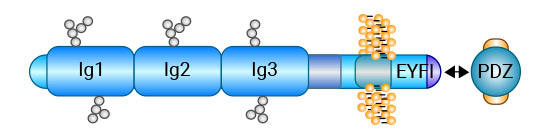
圖1. CADM1的結構 [9]
2.2 CADM1的表達和功能
CADM1表達于腦、睪丸、肺和各種上皮組織,通過其在相鄰細胞間的同質傳遞相互作用,在上皮細胞粘附中發揮重要作用。CADM1與肌動蛋白-結合蛋白、4.1B/DAL-1、和支架蛋白、膜-相關胍酸激酶(包括MPP1、MPP2、MPP3、CASK和Pals2)的成員相結合,參與不同的生物學過程 [10-11]。研究發現,CADM1是一種新的腫瘤抑制基因(TSG),具有抑制細胞過度增殖的作用。CADM1表達失活與腫瘤侵襲轉移的程度密切關系。因此,有望以CADM1作為靶點進一步開展針對腫瘤轉移的控制和治療方面的研究 [10-11]。
3. CADM1相關的作用機制
CADM1作為一種新近發現的抑癌基因,廣泛參與了細胞間黏附、細胞運動、信號轉導以及免疫調節。盡管眾多學者對探討基因腫瘤抑制方面做了大量研究,但對于該基因在體內的具體功能及其腫瘤抑制的分子機制尚不明確。
3.1 CADM1和啟動子甲基化
甲基化導致腫瘤抑制基因的失活被認為是導致腫瘤發生的早期機制之一。在肝癌、肺癌、腸癌、胃癌、前列腺癌、卵巢癌、宮頸癌、乳腺癌、胰腺癌、鼻咽癌、神經膠質瘤、急性白血病中均證實了啟動子甲基化引起CADM1表達缺失與腫瘤發生密切相關。
在肝癌中,選取在細胞周期和生長中發揮重要作用的關鍵蛋白:P15、P16、P21、P27、Cyclin D1、Cyclin D3、CDK4、CDK6、phopho-Rb、Rb和E2F1,Western Blot實驗結果表明,過表達CADM1可上調細胞周期核心蛋白Rb的表達。Rb蛋白通過抑制轉錄因子E2F的活性,從而防止細胞進入S期,保持細胞在G0/G1期處于休眠狀態,使細胞生長停滯,是一個非常重要的抑制腫瘤發生的因子。因此,CADM1可能通過Rb-E2F通路,抑制腫瘤細胞生長 [12-13]。
在卵巢癌中,CADM1過表達會同時上調IFI44L和C4BPA的表達,激活LXR/RXR通路,抑制PI3K/Akt/mTOR。此外,CADM1過表達可抑制GF-1和FXYD2基因的表達來抑制PI3K/Akt/mTOR通路的上游激活。當PI3K/Akt/mTOR通路被抑制時,下游APP、EDN1和Rapla下調,而TGFBI上調。此外,ROS/JNK被激活,導致凋亡蛋白caspase-3和caspase-8表達上調,最終導致卵巢癌細胞凋亡。同時,TGFBI和ROS/JNK通路也可抑制卵巢癌的增殖和轉移(圖2) [14]。
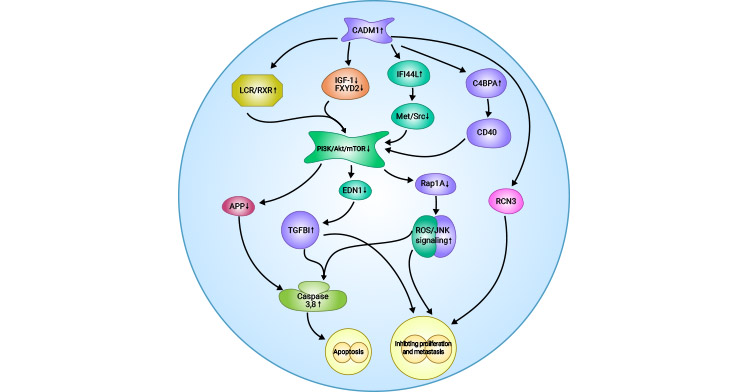
圖2. CADM1 抑制卵巢癌的潛在機制 [14]
3.2 CADM1和腫瘤免疫逃逸
另有研究揭示,CADM1的抑瘤作用依賴于T細胞介導的免疫監測。活性的自然殺傷(NK)細胞和CD8+T細胞能通過細胞上表達的CRTAM受體識別CADM1。在體外,CRTAM-CADM1相互作用,可促使細胞發揮細胞毒性作用,同時促進CD8+T細胞分泌γ-干擾素。在體內,CRTAM-CADM1相互作用可促進NK細胞介導的排斥作用,從而殺傷表達CADM1的腫瘤細胞(圖3) [15]。
當表達CADM1的腫瘤細胞注射到裸鼠腹腔內的早期階段,腫瘤細胞能夠有效的被NK細胞殺傷 [15]。因此推測,CADM1是一種腫瘤抗原分子,其表達丟失可能是腫瘤細胞逃避宿主免疫監視的原因。
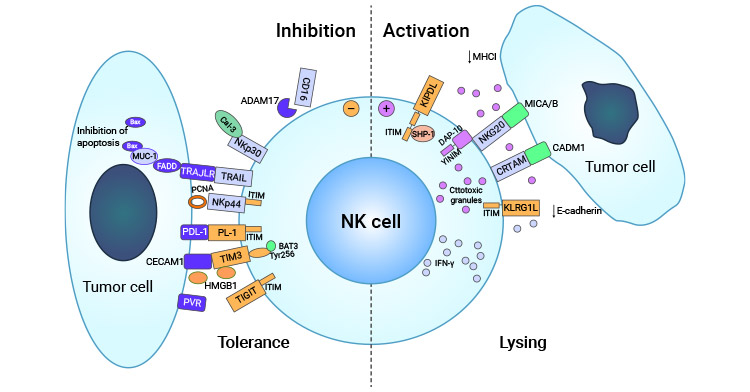
圖3. CRTAM-CADM1參與腫瘤免疫逃逸機制 [15]
4. CADM1在癌癥中的作用
4.1 CADM1和肺癌
染色體片段11q23.2上的CADM1基因最初被鑒定為非小細胞肺癌(NSCLC)中的抑癌基因,其抑癌活性在裸鼠中得到證實 [16]。此外,CADM1與人類表皮生長因子受體HER2和整合素α6β4形成復合物,介導抑制肺鱗狀細胞癌增殖和侵襲的作用,從而破壞信號傳導因子及轉錄激活因子STAT3(圖4) [17]。在肺腺癌中研究發現,CADM1甲基化與吸煙因素相關,推測吸煙可能是導致基因甲基化的一個原因,間接說明吸煙與肺癌的關系。進一步研究表明,CADM1通過細胞質帶4.1和MAGu K蛋白相互作用抑制肺腺癌細胞增殖 [18]。
此外,通過重組病毒Ad sp-E1A(Δ24)-TSLC1(CADM1)插入雙調控Ad sp-E1A(Δ24)載體中,構建了重組病毒Ad sp-E1A-TSLC 1(CADM1),Ad sp-E1A(Δ24)-TSLC1劑量依賴性地抑制肺癌細胞的活性。CADM1高表達,肺癌細胞凋亡率明顯升高,caspase-8、caspase-3和PARP活化增加。在裸鼠移植瘤模型中,瘤內注射Ad·sp-E1A(Δ24)-TSLC 1(CADM1)可明顯抑制腫瘤體積,提高存活率 [19]。
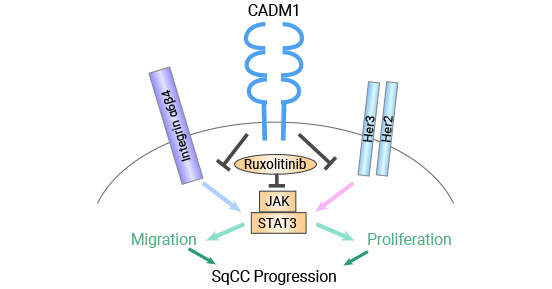
圖4. CADM1通過降低STAT3活性抑制鱗狀細胞癌 [17]
4.2 CADM1和大腸癌
在大腸癌中,研究提示CADM1可通過FERM結構域直接與DAL-1/4.1B蛋白相互作用,共同發揮抑制腫瘤侵襲轉移的功能。在DAL-1/4.1B基因敲除小鼠的研究中,發現CADM1的分布并不受DAL-1/4.1B基因敲除的影響,而CADM1包含的FERM結合域的缺失會影響DAL-1/4.1B在細胞膜的表達 [20-22]。
CADM1和DAL-1/4.1B是構成參與組織肌動蛋白細胞骨架級聯的要素,從而建立相鄰細胞的穩定黏附。一旦CADM1失活就會使DAL-1/4.1B及MPP3表達減少,從而影響細胞膜和骨架的黏附和連接的穩定,參與大腸癌的發生、發展和轉移。在結腸腺癌中,CADM1通過增加整合素α6β4相互作用來調節細胞的穩定性,從而減少腫瘤細胞的運動 [21-22]。
4.3 CADM1和宮頸癌
在宮頸癌中,CADM1啟動子在11個宮頸癌細胞株中有9個(82%)發生高甲基化,CADM1基因通過啟動子高度甲基化沉默是從高危型HPV、高風險宮頸上皮內瘤變(cervical intraepithelial neoplasia,CIN)病變發展到浸潤性宮頸癌過程中的一個常見現象 [23-24]。
4.4 CADM1和其它癌癥
在肝癌中,CADM1啟動子區甲基化的肝癌患者術后腫瘤復發率明顯高于啟動子區無甲基化患者 [25]。在卵巢癌中,CADM1通過抑制PI3K/Akt/m TOR的激活,誘導細胞凋亡,并抑制卵巢癌細胞的增殖和轉移 [26]。在T細胞白血病中,CADM1與Tiam1相互作用,促進人類T細胞白血病病毒I型轉化和成人T細胞白血病細胞侵襲周圍組織(圖5) [27]。
在黑色素瘤中,CADM1過表達其抑制作用可能是由于MMP2和MMP9表達受到抑制 [28]。在永生化腎細胞中,CADM1與受體酪氨酸激酶HER3結合,減少細胞增殖 [29-30]。在鱗狀上皮癌中,CADM1表達缺失的腫瘤患者預后比陽性表達患者差,使其成為調控鱗狀上皮癌進展的候選基因 [31]。
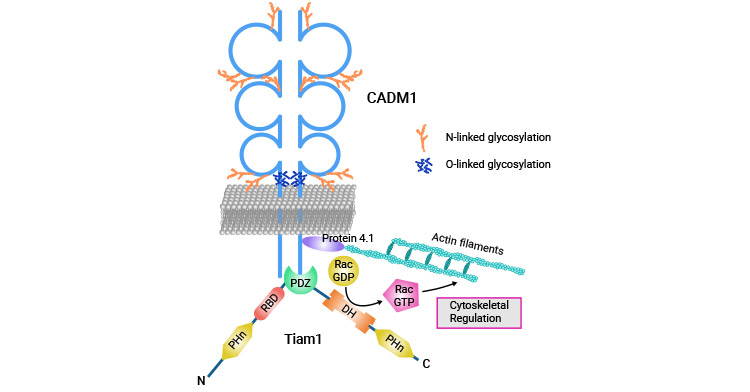
圖5. CADM1與Tiam1相互作用會促進人類T細胞白血病 [27]
5. CADM1的臨床研究前景
CADM1作為一種新近發現的TSG抑癌基因,其缺失與啟動子甲基化關系密切,通過檢測啟動子甲基化,CADM1可作為腫瘤診斷、監測預后的一種有效的生物標記。此外,CADM1在腫瘤免疫監視中起到重要的作用,其低表達或缺失與腫瘤免疫逃避密切相關。目前已有一些針對CADM1的藥物在開發或試驗中,如構建重組病毒Ad sp-E1A(Δ24)-TSLC1(CADM1)可引起腫瘤細胞凋亡和病毒顆粒在腫瘤組織中的傳播。CADM1作為一種潛在的腫瘤抑制基因,通過增強CADM1的功能,將在腫瘤臨床藥物應用方面具有廣闊的前景。
為鼎力協助各藥企針對CADM1在腫瘤等疾病在臨床中的研究,CUSABIO推出CADM1活性蛋白產品(CSB-MP004425MO),助力您在CADM1機制方面的研究或其潛在臨床價值的探索(點擊查看CADM1系列產品:CADM1蛋白 ;CADM1抗體)。
CADM1蛋白:
Recombinant Mouse Cell adhesion molecule 1(Cadm1),partial (Active)
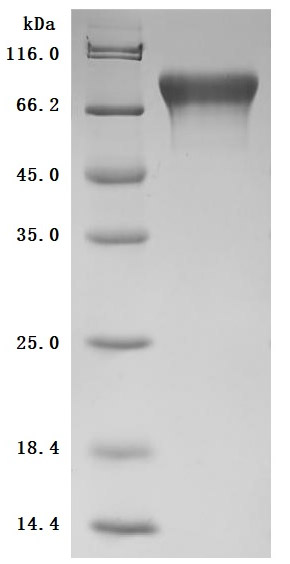
The purity was greater than 98.6% as determined by SDS-PAGE. (Tris-Glycine gel) Discontinuous SDS-PAGE (reduced) with 5% enrichment gel and 15% separation gel.
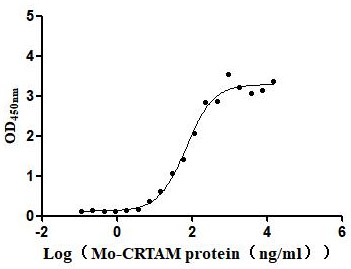
Immobilized Mouse CADM1 at 2μg/mL can bind Mouse CRTAM (CSB-MP614820MO), the EC50 is 52.61-92.92 ng/mL.
參考文獻:
[1] Verschueren, Erik, et al. "The immunoglobulin superfamily receptome defines cancer-relevant networks associated with clinical outcome." Cell 182.2 (2020): 329-344.
[2] Huene, Aidan L., et al. "A family of unusual immunoglobulin superfamily genes in an invertebrate histocompatibility complex." Proceedings of the National Academy of Sciences 119.40 (2022): e2207374119.
[3] Soltantoyeh, Tahereh, et al. "Chimeric antigen receptor (CAR) T cell therapy for metastatic melanoma: challenges and road ahead." Cells 10.6 (2021). 1450.
[4] von Lersner, Ariana, Lenny Droesen, and Andries Zijlstra. "Modulation of cell adhesion and migration through regulation of the immunoglobulin superfamily member ALCAM/CD166." clinical & experimental metastasis 36.2 (2019): 87-95.
[5] Velychko, L. M., et al. "Expression of lymphocyte activation markers CD 54 (ICAM-1), CD 5, CD 95 (FAS) and neutrophil activation marker CD15 in the peripheral blood of patients with intermediate uveitis and healthy individuals." (2021).
[6] Wai Wong, Chee, Danielle E. Dye, and Deirdre R. Coombe. "The role of immunoglobulin superfamily cell adhesion molecules in cancer metastasis." International journal of cell biology 2012 (2012).
[7] Kasai, Yutaka, et al. "Trans-homophilic interaction of CADM1 promotes organ infiltration of T-cell lymphoma by adhesion to vascular endothelium." Cancer science 113.5 (2022): 1669-1678.
[8] Funaki, Toko, et al. "CADM1 promotes malignant features of small-cell lung cancer by recruiting 4.1 R to the plasma membrane." Biochemical and Biophysical Research Communications 534 (2021): 172-178.
[9] Salie, Muneeb. Investigating candidate genes identified by genome-wide studies of granulomatous diseases in susceptibility to tuberculosis: ANXA11 and the CADM family. Diss. Stellenbosch: University of Stellenbosch, 2010.
[10] Wikman, Harriet, et al. "Loss of CADM1 expression is associated with poor prognosis and brain metastasis in breast cancer patients." oncotarget 5.10 ( 2014): 3076.
[11] Sakurai-Yageta, Mika, et al. "Tumor suppressor CADM1 is involved in epithelial cell structure." Biochemical and biophysical research communications 390.3 (2009): 977-982.
[12] Watanabe, Toshiki. "Adult T-cell leukemia: molecular basis for clonal expansion and transformation of HTLV-1-infected T cells. "Blood. The Journal of the American Society of Hematology 129.9 (2017): 1071-1081.
[13] Zhang, Wu, et al. "CADM1 regelates the G1/S transition and represses tumorigenicity through the Rb-E2F pathway in hepatocellular carcinoma." Hepatobiliary & Pancreatic Diseases International 15.3 (2016): 289-296.
[14] Si, Xiaoqiang, et al. "CADM1 inhibits ovarian cancer cell proliferation and migration by potentially regulating the PI3K/Akt/mTOR pathway." Biomedicine & Pharmacotherapy 123 (2020): 109717.
[15] Vuleti?, Ana, et al. "Cross-talk between tumor cells undergoing epithelial to mesenchymal transition and natural killer cells in tumor microenvironment in colorectal cancer." Frontiers in Cell and Developmental Biology (2021): 3107.
[16] Kuramochi, Masami, et al. "TSLC1 is a tumor-suppressor gene in human non-small-cell lung cancer." Nature genetics 27.4 (2001): 427-430.
[17] Vallath, Sabari, et al. "CADM1 inhibits squamous cell carcinoma progression by reducing STAT3 activity." Scientific Reports 6.1 (2016): 1-12.
[18] Murakami, Shigefumi, et al. "Trans-homophilic interaction of CADM1 activates PI3K by forming a complex with MAGuK-family proteins MPP3 and Dlg." PLoS One 9.2 (2014): e82894.
[19] Lei, Wen, et al. "Tumor suppressor in lung cancer-1 (TSLC1) mediated by dual-regulated oncolytic adenovirus exerts specific antitumor actions in a mouse model." Acta Pharmacologica Sinica 34.4 (2013): 531-540.
[20] Ru Zhang, Zhenglei Xu, and Qinghong Tan. "Expression of CADM1 and DAL-1/4.1 B in Colorectal Cancer. "Chinese Journal of Gerontology 14 (2014): 3845-3847 .
[21] Beaulieu, Jean-François. "Integrin α6β4 in colorectal cancer: expression, regulation, functional alterations and use as a biomarker. "Cancers 12.1 ( 2019): 41.
[22] Cai, Qian, Anding Zhu, and Li Gong. "Exosomes of glioma cells deliver miR-148a to promote proliferation and metastasis of glioblastoma via targeting CADM1." Bulletin du cancer 105.7-8 (2018): 643-651.
[23] Hamashima, Chisato. "Emerging technologies for cervical cancer screening." Japanese Journal of Clinical Oncology 51.9 (2021): 1462-1470.
[24] van Zummeren, Marjolein, et al. "HPV E4 expression and DNA hypermethylation of CADM1, MAL, and miR124-2 genes in cervical cancer and precursor lesions." Modern Pathology 31.12 (2018): 1842-1850.
[25] Wu, Dong-Mei, et al. "Down-regulated lncRNA DLX6-AS1 inhibits tumorigenesis through STAT3 signaling pathway by suppressing CADM1 promoter methylation in liver cancer stem cells." Journal of Experimental & Clinical Cancer Research 38 (2019): 1-17.
[26] Si, Xiaoqiang, et al. "CADM1 inhibits ovarian cancer cell proliferation and migration by potentially regulating the PI3K/Akt/mTOR pathway." Biomedicine & Pharmacotherapy 123 (2020): 109717.
[27] Masuda, Mari, et al. "CADM1 interacts with Tiam1 and promotes invasive phenotype of human T-cell leukemia virus type I-transformed cells and adult T- cell leukemia cells." Journal of Biological Chemistry 285.20 (2010): 15511-15522.
[28] You, Yan, et al. "CADM1/TSLC1 inhibits melanoma cell line A375 invasion through the suppression of matrix metalloproteinases." Molecular Medicine Reports 10.5 (2014): 2621-2626.
[29] Sarkar, Bidhan, et al. "Degradation of p47 by autophagy contributes to CADM1 overexpression in ATLL cells through the activation of NF-κB." Scientific Reports 9.1 (2019): 1-14.
[30] Böhm, Allan, et al. "Molecular mechanisms, diagnostic aspects and therapeutic opportunities of micro ribonucleic acids in atrial fibrillation." International Journal of Molecular Sciences 21.8 (2020): 2742.
[31] Saito-Sasaki, Natsuko, et al. "Cell Adhesion Molecule 1 (CADM1) Is an Independent Prognostic Factor in Patients with Cutaneous Squamous Cell Carcinoma ." Diagnostics 11.5 (2021): 830.