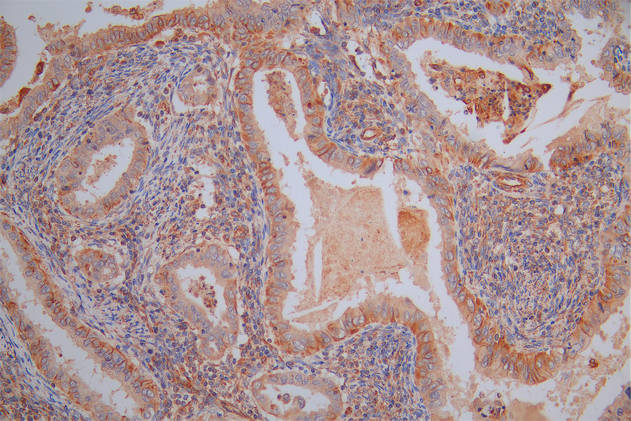
GCGR (crotedumab Biosimilar) Recombinant Monoclonal Antibody
-
貨號:CSB-RA009316MB1HU
-
規格:¥83486
-
其他:
產品詳情
-
產品描述:GCGR(crotedumab Biosimilar Antibody)重組單克隆抗體是一種針對胰高血糖素受體(Glucagon receptor,簡稱GL-R或GCGR)。其來源于重組人GCGR蛋白,通過特異性識別并結合GCGR發揮生物學作用,目前驗證對大鼠具有種屬反應性。 crotedumab藥物主要圍繞2型糖尿病的治療展開。胰高血糖素受體作為調節血糖的關鍵靶點,通過與胰高血糖素結合促進肝糖原分解和糖異生,導致血糖升高。該抗體研發的藥物可阻斷這一信號通路,減少肝臟葡萄糖生成,從而降低血糖水平。臨床前研究顯示,在大鼠模型中,該抗體研發的藥物能顯著改善胰島素抵抗狀態,降低空腹血糖和糖化血紅蛋白水平,且未觀察到嚴重低血糖風險。目前,相關臨床轉化研究正探索其在2型糖尿病患者中的劑量優化和長期安全性,尤其關注對肝腎功能及胰島β細胞功能的影響。 該抗體為代謝疾病機制研究提供了重要工具。由于其明確的種屬反應性,可用于構建大鼠糖尿病模型,深入探究GCGR在糖脂代謝、能量平衡中的調控作用。研究人員常通過腹腔注射或靜脈給藥方式,觀察抗體對大鼠血糖波動、胰島素敏感性及肝臟基因表達譜的影響。此外,該抗體還可與其他代謝靶點藥物聯合使用,為開發多靶點協同治療策略提供實驗依據,助力揭示代謝綜合征的復雜病理網絡。隨著研究深入,其應用范圍有望擴展至肥胖、非酒精性脂肪肝等代謝相關疾病的機制探索。
-
Uniprot No.:
-
基因名:
-
別名:Glucagon receptor;GL-R , GCGR
-
反應種屬:Human
-
免疫原:Recombinant Human GCGR protein
-
免疫原種屬:Homo sapiens (Human)
-
標記方式:Non-conjugated
-
克隆類型:Monoclonal
-
濃度:It differs from different batches. Please contact us to confirm it.
-
保存緩沖液:0.01M PBS,pH7.4
-
產品提供形式:Liquid
-
應用說明:Validation Status
Application-specific performance (e.g., in flow cytometry, ELISA, IHC or other assay formats) has not yet been experimentally verified by CUSABIO. Users are advised to determine the optimal working conditions empirically in their own assay systems.
Guaranteed Quality
① Antibody purity?> 95% tested by SDS-PAGE.
② Endotoxin level < 0.1EU/ug tested by LAL method. -
儲存條件:Upon receipt, store at -20°C or -80°C. Avoid repeated freeze.
-
貨期:In stock
-
用途:It is a non-therapeutic biosimilar antibody, owning the same variable region from the corresponding approved therapeutic antibody. In conclusion, it is a research-grade biosimilar antibody and expressed in mammalian cell, which can be directly used as positive controls in drug discovery or used for rapid verification of the biological functions of target protein.
產品評價

相關產品
靶點詳情
-
功能:G-protein coupled receptor for glucagon that plays a central role in the regulation of blood glucose levels and glucose homeostasis. Regulates the rate of hepatic glucose production by promoting glycogen hydrolysis and gluconeogenesis. Plays an important role in mediating the responses to fasting. Ligand binding causes a conformation change that triggers signaling via guanine nucleotide-binding proteins (G proteins) and modulates the activity of down-stream effectors, such as adenylate cyclase. Promotes activation of adenylate cyclase. Besides, plays a role in signaling via a phosphatidylinositol-calcium second messenger system.
-
基因功能參考文獻:
- 3.0 A-resolution crystal structure of the full-length human glucagon receptor (GCGR) in complex with a glucagon analogue and partial agonist, NNC1702 PMID: 29300013
- work toward the mapping of interactions between the polypeptide hormone glucagon and the glucagon receptor PMID: 28508109
- 3.0 A crystal structure of full-length GCGR containing both the extracellular domain and transmembrane domain in an inactive conformation PMID: 28514451
- This work suggests that RAMP2 may modify the agonist activity and trafficking of the GCGR, with potential relevance to production of new peptide analogs with selective agonist activities. PMID: 28586439
- Data suggest that GCGR activation proceeds via a mechanism in which transmembrane helix 6 (TM6) is held in an inactive conformation by a conserved polar core and a hydrophobic lock (involving intracellular loop 3, IC3); mutations in the corresponding polar core of GCGR disrupt these inhibitory elements, allow TM6 to swing outward, and induce constitutive G protein signaling. PMID: 28356352
- The activation of the GCGR is characterized by the outward movement of the intracellular side of helix VI. In the active state of the GCGR, the Arg173(2.46)-Ser350(6.41) and Glu245(3.50)-Thr351(6.42) hydrogen bonds break, and the chi1 rotamer of Phe322(5.54) changes from perpendicular to parallel to helix VI. PMID: 27094704
- In the glucagon receptor (GCGR) and glucagon-like peptide-1 receptor (GLP-1R), the extracellular domain is required for signaling even when the hormone is covalently linked to the transmembrane domain. PMID: 27226600
- 2.5 A crystal structure of human GCGR in complex with the antagonist MK-0893, which is found to bind to an allosteric site outside the seven transmembrane helical bundle in a position between TM6 and TM7 extending into the lipid bilayer PMID: 27111510
- Molecular dynamics and disulfide crosslinking studies suggest that apo-GCGR can adopt both an open and closed conformation associated with extensive contacts between the ECD and 7TM domain. Glucagon binds to GCGR by a conformational selection mechanism. PMID: 26227798
- glucagon cell adenomatosis with GCGR germline mutations seems to follow an autosomal-recessive trait. PMID: 25695890
- Using a real-time time-resolved FRET-based internalization assay, we show that GLP-1R, GIPR, and GCGR internalize with differential properties PMID: 25451942
- crystal structure of the seven transmembrane helical domain of human GCGR at 3.4 A resolution, and a hybrid model of glucagon bound to GCGR to understand the molecular recognition of the receptor for its native ligand PMID: 23863937
- Letter/Case Report: nonfunctional glucagon cell adenomatosis with no detectable glucagon receptor mutations. PMID: 23407487
- GRA1 is a potent glucagon receptor antagonist with strong antihyperglycemic efficacy in preclinical models and prominent effects on hepatic gene-expression related to amino acid metabolism PMID: 23185367
- F22, V23, M27, and D15 of GCGR are the most important residues for glucagon binding. PMID: 22893257
- in addition to activation of the classic cAMP/protein kinase A (PKA) pathway, activation of GCGR also induced beta-catenin stabilization and activated beta-catenin-mediated transcription PMID: 22438981
- analysis of glucagon receptor antagonists with reduced molecular weight and lipophilicity PMID: 22119466
- The P86S mutant GCGR shows abnormal receptor internalization & calcium mobilization, & causes apoptosis. It cases Mahvash disease (hyperglucagonemia, hypoglycemia, pancreatic neuroendocrine tumors). PMID: 21680267
- substituted cysteine accessibility method and 3D-molecular modeling to study the N-terminal domain; results showed that Asp(63), Arg(116), and Lys(98) are essential for the receptor structure and/or ligand binding PMID: 20647307
- The [Ca2+] response is induced by glucagon mainly via the coupling of GCGR to the Galphaq/11 and Galphai/o proteins. PMID: 19903011
- The Gly40Ser polymorphism of the GCGR gene is associated with higher risk of hypertension and with enhanced proximal tubular sodium reabsorption. PMID: 11692154
- Gly40Ser mutation in the glucagon receptor gene is not associated with type 2 diabetes in a Brazilian population, but a reduction of insulin secretion was observed in Gly40Ser carriers. PMID: 11961492
- Three distinct epitopes on the extracellular face of the glucagon receptor determine specificity for the glucagon amino terminus PMID: 12724331
- Expression of peroxisome proliferator-activated receptor gamma coactivator 1alpha (PGC-1alpha), known to be upregulated in the liver by fasting, was found to abolish the cAMP-dependent downregulation of glucagon receptor mRNA expression in vitro. PMID: 17374560
顯示更多
收起更多
-
亞細胞定位:Cell membrane; Multi-pass membrane protein.
-
蛋白家族:G-protein coupled receptor 2 family
-
數據庫鏈接:
Most popular with customers
-
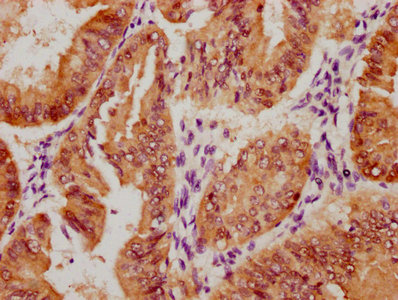
Phospho-YAP1 (S127) Recombinant Monoclonal Antibody
Applications: ELISA, WB, IHC
Species Reactivity: Human
-
-
-
-
-
-
-