Recombinant Mouse Potassium voltage-gated channel subfamily A member 2 (Kcna2)
-
中文名稱(chēng):小鼠Kcna2重組蛋白
-
貨號(hào):CSB-CF012007MO
-
規(guī)格:
-
來(lái)源:in vitro E.coli expression system
-
其他:
產(chǎn)品詳情
-
基因名:Kcna2
-
Uniprot No.:
-
別名:Kcna2; Potassium voltage-gated channel subfamily A member 2; MK2; Voltage-gated potassium channel subunit Kv1.2
-
種屬:Mus musculus (Mouse)
-
蛋白長(zhǎng)度:Full length protein
-
表達(dá)區(qū)域:1-499
-
氨基酸序列MTVATGDPVDEAAALPGHPQDTYDPEADHECCERVVINISGLRFETQLKTLAQFPETLLG DPKKRMRYFDPLRNEYFFDRNRPSFDAILYYYQSGGRLRRPVNVPLDIFSEEIRFYELGE EAMEMFREDEGYIKEEERPLPENEFQRQVWLLFEYPESSGPARIIAIVSVMVILISIVSF CLETLPIFRDENEDMHGGGVTFHTYSNSTIGYQQSTSFTDPFFIVETLCIIWFSFEFLVR FFACPSKAGFFTNIMNIIDIVAIIPYFITLGTELAEKPEDAQQGQQAMSLAILRVIRLVR VFRIFKLSRHSKGLQILGQTLKASMRELGLLIFFLFIGVILFSSAVYFAEADERDSQFPS IPDAFWWAVVSMTTVGYGDMVPTTIGGKIVGSLCAIAGVLTIALPVPVIVSNFNYFYHRE TEGEEQAQYLQVTSCPKIPSSPDLKKSRSASTISKSDYMEIQEGVNNSNEDFREENLKTA NCTLANTNYVNITKMLTDV
Note: The complete sequence may include tag sequence, target protein sequence, linker sequence and extra sequence that is translated with the protein sequence for the purpose(s) of secretion, stability, solubility, etc.
If the exact amino acid sequence of this recombinant protein is critical to your application, please explicitly request the full and complete sequence of this protein before ordering. -
蛋白標(biāo)簽:N-terminal 10xHis-tagged
-
產(chǎn)品提供形式:Liquid or Lyophilized powder
Note: We will preferentially ship the format that we have in stock, however, if you have any special requirement for the format, please remark your requirement when placing the order, we will prepare according to your demand. -
緩沖液:Lyophilized from Tris/PBS-based buffer, 6% Trehalose, pH 8.0
-
儲(chǔ)存條件:Store at -20°C/-80°C upon receipt, aliquoting is necessary for mutiple use. Avoid repeated freeze-thaw cycles.
-
保質(zhì)期:The shelf life is related to many factors, storage state, buffer ingredients, storage temperature and the stability of the protein itself.
Generally, the shelf life of liquid form is 6 months at -20°C/-80°C. The shelf life of lyophilized form is 12 months at -20°C/-80°C. -
貨期:Basically, we can dispatch the products out in 1-3 working days after receiving your orders. Delivery time may differ from different purchasing way or location, please kindly consult your local distributors for specific delivery time.Note: All of our proteins are default shipped with normal blue ice packs, if you request to ship with dry ice, please communicate with us in advance and extra fees will be charged.
-
注意事項(xiàng):Repeated freezing and thawing is not recommended. Store working aliquots at 4°C for up to one week.
-
Datasheet & COA:Please contact us to get it.
產(chǎn)品評(píng)價(jià)

相關(guān)產(chǎn)品
靶點(diǎn)詳情
-
功能:Voltage-gated potassium channel that mediates transmembrane potassium transport in excitable membranes, primarily in the brain and the central nervous system, but also in the cardiovascular system. Prevents aberrant action potential firing and regulates neuronal output. Forms tetrameric potassium-selective channels through which potassium ions pass in accordance with their electrochemical gradient. The channel alternates between opened and closed conformations in response to the voltage difference across the membrane. Can form functional homotetrameric channels and heterotetrameric channels that contain variable proportions of KCNA1, KCNA2, KCNA4, KCNA5, KCNA6, KCNA7, and possibly other family members as well; channel properties depend on the type of alpha subunits that are part of the channel. Channel properties are modulated by cytoplasmic beta subunits that regulate the subcellular location of the alpha subunits and promote rapid inactivation of delayed rectifier potassium channels. In vivo, membranes probably contain a mixture of heteromeric potassium channel complexes, making it difficult to assign currents observed in intact tissues to any particular potassium channel family member. Homotetrameric KCNA2 forms a delayed-rectifier potassium channel that opens in response to membrane depolarization, followed by slow spontaneous channel closure. In contrast, a heteromultimer formed by KCNA2 and KCNA4 shows rapid inactivation. Contributes to the regulation of action potentials in neurons. KCNA2-containing channels play a presynaptic role and prevent hyperexcitability and aberrant action potential firing. Response to toxins that are selective for KCNA1, respectively for KCNA2, suggests that heteromeric potassium channels composed of both KCNA1 and KCNA2 play a role in pacemaking and regulate the output of deep cerebellar nuclear neurons. Response to toxins that are selective for KCNA2-containing potassium channels suggests that in Purkinje cells, dendritic subthreshold KCNA2-containing potassium channels prevent random spontaneous calcium spikes, suppressing dendritic hyperexcitability without hindering the generation of somatic action potentials, and thereby play an important role in motor coordination. KCNA2-containing channels play a role in GABAergic transmission from basket cells to Purkinje cells in the cerebellum, and thereby play an import role in motor coordination. Plays a role in the induction of long-term potentiation of neuron excitability in the CA3 layer of the hippocampus. May function as down-stream effector for G protein-coupled receptors and inhibit GABAergic inputs to basolateral amygdala neurons. May contribute to the regulation of neurotransmitter release, such as gamma-aminobutyric acid (GABA). Contributes to the regulation of the axonal release of the neurotransmitter dopamine. Reduced KCNA2 expression plays a role in the perception of neuropathic pain after peripheral nerve injury, but not acute pain. Plays a role in the regulation of the time spent in non-rapid eye movement (NREM) sleep.
-
基因功能參考文獻(xiàn):
- G9a contributes to neuropathic pain development through epigenetic silencing of Kcna2 in the axotomized dorsal root ganglion. PMID: 27874088
- Results show that MK2 activation induces MRTF-A phosphorylation at S351 and S371 upon stress. PMID: 27492266
- Kv1.2 mediates heterosynaptic modulation of direct cortical synaptic inputs in CA3 pyramidal cells PMID: 26047212
- analysis of fine-tuning of voltage sensitivity of the Kv1.2 potassium channel by interhelix loop dynamics PMID: 23413033
- This study showed that MK2 kinase is activated by TcdA and TcdB and regulates the expression of proinflammatory cytokines. PMID: 23264053
- Mk2 homozygous deletion in mice impedes the induction of experimental colitis by dextran sodium sulfate, confirming the notion that p38/Mk2 is involved in this inflammatory response. PMID: 23381627
- The dynamic Sig-1R-Kv1.2 complex represents a mechanism that shapes neuronal and behavioral response to cocaine. PMID: 23332758
- the contribution of Kv1.2 in the regulation of nigrostriatal DA release by the D2-AR and thereby offer a novel mechanism by which DA release is regulated. PMID: 21233214
- These results suggest that independent of known mutations in Kcna1 encoding Kv1.1, Kcna2 mutations may be important molecular correlates underlying human cerebellar ataxic disease. PMID: 20696761
- Data show that PSD-95 colocalizes precisely with Kv1 potassium channels and Caspr2 at juxtaparanodes, and that a macromolecular complex of Kv1 channels and PSD-95 can be immunopurified from mammalian brain and spinal cord. PMID: 12438413
- Kcna2-null mice exhibited increased seizure susceptibility but, in contrast to Kcna1-null mice, hypoexcitability and enlarged Kv1 currents in auditory neurons. PMID: 17634333
- Kv1.2, a mammalian homologue of Shaker, regulates neuronal excitability and affects NREM sleep PMID: 17925011
- cluster of cytoplasmic C-terminal phosphorylation sites regulates Kv1.2 trafficking PMID: 18056633
- K(v)1.1 and K(v)1.2 were predominantly expressed in distinct EGC phenotypes. K(v)1.2 was also observed in distinct neuron subpopulations. PMID: 19549557
顯示更多
收起更多
-
亞細(xì)胞定位:Cell membrane; Multi-pass membrane protein. Membrane. Cell projection, axon. Cell junction, synapse. Endoplasmic reticulum membrane. Cell projection, lamellipodium membrane. Cell junction, synapse, synaptosome. Cell junction, synapse, presynaptic cell membrane. Cell projection, dendrite. Perikaryon. Cell junction, paranodal septate junction.
-
蛋白家族:Potassium channel family, A (Shaker) (TC 1.A.1.2) subfamily, Kv1.2/KCNA2 sub-subfamily
-
組織特異性:Detected in brain. Detected in cerebellum. Detected in mitral cells in the olfactory bulb. Detected in cochlea. Detected in cerebellum, particularly in the basket cell axon plexus and in the terminal regions around Purkinje cells. Detected in juxtaparanod
-
數(shù)據(jù)庫(kù)鏈接:
Most popular with customers
-
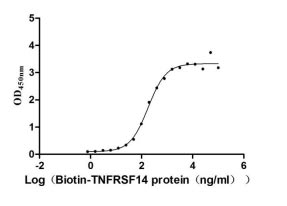
Recombinant Human B- and T-lymphocyte attenuator (BTLA), partial (Active)
Express system: Mammalian cell
Species: Homo sapiens (Human)
-
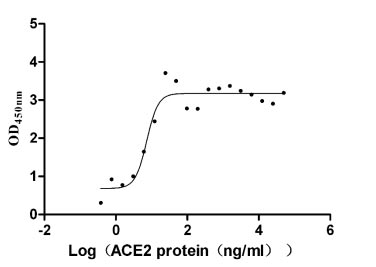
Recombinant Macaca fascicularis Angiotensin-converting enzyme (ACE2), partial (Active)
Express system: Mammalian cell
Species: Macaca fascicularis (Crab-eating macaque) (Cynomolgus monkey)
-
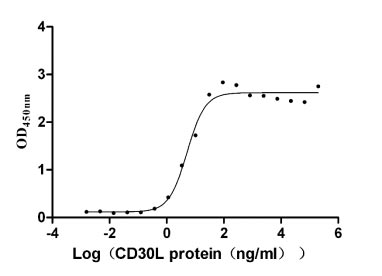
Recombinant Human Tumor necrosis factor ligand superfamily member 8 (TNFSF8), partial (Active)
Express system: Mammalian cell
Species: Homo sapiens (Human)
-
-AC1.jpg)
Recombinant Mouse Claudin-18.2 (Cldn18.2)-VLPs (Active)
Express system: Mammalian cell
Species: Mus musculus (Mouse)
-
-AC5.jpg)
Recombinant Human Claudin-6 (CLDN6)-VLPs (Active)
Express system: Mammalian cell
Species: Homo sapiens (Human)
-
-AC1.jpg)
Recombinant Human Dickkopf-related protein 1 (DKK1) (Active)
Express system: Mammalian cell
Species: Homo sapiens (Human)
-
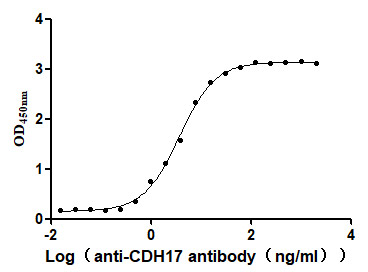
Recombinant Human Cadherin-17 (CDH17), partial (Active)
Express system: Mammalian cell
Species: Homo sapiens (Human)
-
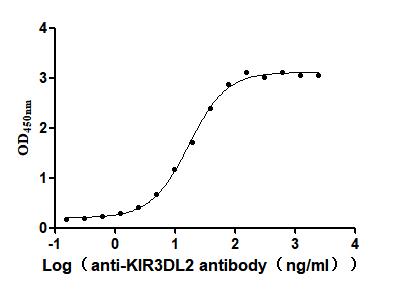
Recombinant Human Killer cell immunoglobulin-like receptor 3DL2 (KIR3DL2), partial (Active)
Express system: Mammalian cell
Species: Homo sapiens (Human)