MCPH1 Antibody
-
中文名稱:MCPH1兔多克隆抗體
-
貨號:CSB-PA443473
-
規(guī)格:¥2024
-
圖片:
-
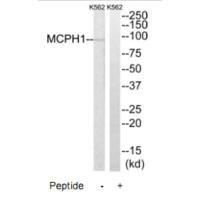 Western blot analysis of extracts from K562 cells, using MCPH1 antibody.
 -
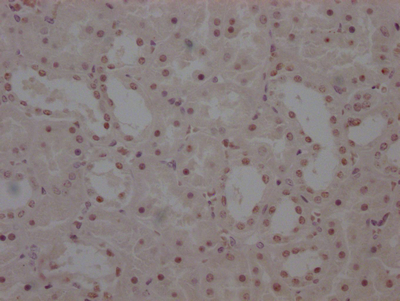
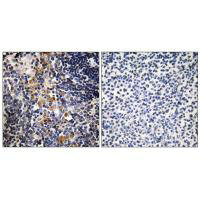 Immunohistochemistry analysis of paraffin-embedded human thymus gland tissue using MCPH1 antibody.
-
-
其他:
產(chǎn)品詳情
-
產(chǎn)品名稱:Rabbit anti-Homo sapiens (Human) MCPH1 Polyclonal antibody
-
Uniprot No.:
-
基因名:MCPH1
-
宿主:Rabbit
-
反應(yīng)種屬:Human
-
免疫原:Synthesized peptide derived from internal of Human MCPH1.
-
免疫原種屬:Homo sapiens (Human)
-
克隆類型:Polyclonal
-
純化方式:The antibody was affinity-purified from rabbit antiserum by affinity-chromatography using epitope-specific immunogen.
-
濃度:It differs from different batches. Please contact us to confirm it.
-
產(chǎn)品提供形式:Liquid
-
應(yīng)用范圍:ELISA,WB,IHC
-
推薦稀釋比:
Application Recommended Dilution WB 1:500-1:3000 IHC 1:50-1:100 -
Protocols:
-
儲存條件:Upon receipt, store at -20°C or -80°C. Avoid repeated freeze.
-
貨期:Basically, we can dispatch the products out in 1-3 working days after receiving your orders. Delivery time maybe differs from different purchasing way or location, please kindly consult your local distributors for specific delivery time.
-
用途:For Research Use Only. Not for use in diagnostic or therapeutic procedures.
產(chǎn)品評價

相關(guān)產(chǎn)品
靶點詳情
-
功能:Implicated in chromosome condensation and DNA damage induced cellular responses. May play a role in neurogenesis and regulation of the size of the cerebral cortex.
-
基因功能參考文獻:
- Tumor suppressor functions of MCPH1/BRIT1 and BRCA1; links with the inactivation of the functional form of hTERT and the activation of dominant negative splice variants of hTERT. PMID: 29860064
- MCPH1 interacts with and promotes the E3 ligase betaTrCP2 to degrade Cdc25A independent of DNA damage. Overexpression of betaTrCP2 or the knockdown of Cdc25A remedies the high mitotic index and rescues the premature differentiation of Mcph1-deficient neuroprogenitors in vivo MCPH1 itself is degraded by APC/CCdh1, but not APC/CCdc20, in late mitosis and G1 phase. PMID: 29150431
- Candidate tumor suppressor gene MCPH1 is mutated in colorectal and gastric cancers. PMID: 27718016
- Characterization of the effects of MCPH1 loss-of-function on chromosome morphology. PMID: 25845520
- These findings collectively provide strong evidence for MCHP1 being a novel breast cancer susceptibility gene, which warrants further investigations in other populations. PMID: 26820313
- Data indicate splice-acceptor site homozygous mutation in intron 4 of microcephalin (MCPH1) gene in 2 children. PMID: 26192461
- in addition to its role in brain development, MCPH1 also functions as a tumor suppressor gene and is directly regulated by miR-27a. PMID: 25197360
- SNTB1 and MCPH1 are located on chromosome 8, which may be involved in neuroticism, avoidant personality and depression. PMID: 24975899
- Phosphorylation of BRIT1 protein coordinates TopBP1 protein recruitment and amplifies ATR signaling in cell DNA damage. PMID: 25301947
- MCPH1 has an important role in regulating cell growth through regulating the cell cycle and apoptosis PMID: 24633962
- This study identified MCPH1 significantly associated loci with a biologically plausible role in schizophrenia. PMID: 24507884
- microcephalin and ASPM expression are deregulated in epithelial ovarian cancer progression PMID: 24830737
- Low MCPH1 protein expression is associated with lung tumorigenesis. PMID: 24460291
- Reduced protein expression of MCPH1 is associated with breast carcinoma. PMID: 23117476
- Polymorphism in MCPH1 gene is associated with pancreatic cancer. PMID: 23908141
- BRIT1 regulates p53 stability and functions as a tumor suppressor in breast cancer. PMID: 23729656
- in addition to its role in brain development, MCPH1 also functions as a tumor suppressor gene and is regulated by miR-27a PMID: 23472065
- The divergence of MCPH1 protein sequences under Darwinian positive selection led to functional modifications, providing a possible molecular mechanism of how MCPH1 contributed to brain enlargement during primate evolution and human origin. PMID: 23697381
- MCPH1 also functions as a tumor suppressor in oral squamous cell carcinoma PMID: 23472065
- The MCPH1 polymorphisms and protein expression were associated with tumorigenesis in breast cancer PMID: 23296058
- MCPH1 encodes different isoforms that are differentially regulated at the transcript level and have different functions at the protein level PMID: 22952573
- MCPH1 recruitment to sites of DNA damage is linked to both states of histone H2A.X. PMID: 22908299
- the crystal structures of MCPH1 natural variant (A761) C-terminal tandem BRCT domains alone as well as in complex with gammaH2AX tail PMID: 22154951
- The MCPH1 promoter region was sequenced in human, chimpanzee and rhesus macaque; sequence comparison of vertebrate species suggested that the identified E2F1 binding motif is primate specific. PMID: 22136275
- It was shown that MCPH1 directly binds to the promoter of human telomerase reverse transcriptase and represses telomerase activity. An intact N terminal BRCT domain was essential for the proper inhibiting function of MCPH1. PMID: 22240313
- the biochemical, structural, and cellular determinants of the novel interaction between MCPH1 and Cdc27 and suggest that this interaction may occur within the larger context of MCPH1-APC/C. PMID: 22139841
- MCPH1 expression is downregulated in blood cells of CML patients compared to control subjects; this downregulation is independent of BCR/ABL. CML cells exhibit defective G2/M arrest; data confirm role of MCPH1 as regulator of G2/M checkpoint. PMID: 21934293
- these findings show that genetic variants in the microcephalin 1 locus are suggestively associated with the risk of epirubicin-induced adverse drug reactions. PMID: 21799462
- MCPH1 regulates chromosome condensation and shaping as a composite modulator of condensin II PMID: 21911480
- Microcephalin is an independent predictor of breast cancer-specific survival in invasive ductal breast cancer patients and may prove to be a useful biomarker for the identification of aggressive breast cancers PMID: 20632086
- SET is an important regulator of chromosome condensation/decondensation and disruption of the MCPH1-SET interaction might be important for the pathogenesis of primary microcephaly PMID: 21515671
- Results indicate that the DNA damage response in human cells with truncating MCPH1 mutations differs significantly from the damage responses in cells of certain model organisms and in cells depleted of MCPH1 by RNAi. PMID: 21150325
- The first study of MCPH1 in a large cohort of non-consanguineous patients with microcephaly, is reported. PMID: 20949544
- Craniosynostosis-microcephaly with chromosomal breakage and other abnormalities is caused by a truncating MCPH1 mutation PMID: 20101680
- Compared with other BRCT domain structures, the most striking differences are an elongated, ordered beta1-alpha1 loop and an adjacent hydrophobic pocket. PMID: 19925808
- discuss our current findings and future perspectives about how BRIT1/MCPH1, a human disease gene, specifies the function of chromatin remodelers and links chromatin remodeling to genome maintenance.[review] PMID: 19829069
- Identification of microcephalin, a protein implicated in determining the size of the human brain, which is mapped to the MCPH1 locus and is mutated in primary microcephaly. PMID: 12046007
- microcephalin and ASPM determine the size of the human brain PMID: 12571366
- Mcph1 is involved in DNA damage-induced cellular responses and may have a role in regulation of Brca1 and/or Chk1 PMID: 15220350
- findings show that one genetic variant of Microcephalin in modern humans, which arose approximately 37,000 years ago, increased in frequency too rapidly to be compatible with neutral drift; this indicates that it has spread under strong positive selection PMID: 16151009
- Data suggest that the microcephaly observed in patients with MCPH1 deficiencies is due to disruption of the ATR-BRCA1-Chk1 signaling pathway that is also disrupted in Seckel syndrome patients. PMID: 16217032
- The study found no evidence that the selected alleles of MCPH1 and ASPM were associated with increases or decreases in brain volume. PMID: 16687438
- We conclude that MCPH1 has a function downstream of Chk1 in the ATR-signalling pathway. PMID: 16783362
- BRIT1 is a crucial DNA damage regulator in the ATM/ATR pathways and suggest that it functions as a tumor suppressor gene PMID: 16872911
- review: MCPH1 functions in the ATR-dependent DNA damage response pathway. Additionally, MCPH1 has a function in the regulation of mitotic entry that is ATR-independent PMID: 17102619
- Studies using 2393 subjects do not support a detectable association between the recent adaptive evolution of either ASPM or Microcephalin and changes in IQ. PMID: 17220170
- no relationship was found between polymorphisms of brain regulator gene Microcephalin Microcephalin and any general mental ability, head circumference and social intelligence PMID: 17251122
- phenotypes other than brain size may have been selected for in ASPM and MCPH1 variants during evolution of modern humans. PMID: 17566767
- MCPH1 functions in an H2AX-dependent but MDC1-independent pathway in response to DNA damage PMID: 17925396
- A non-synonymous SNP (rs1057090, V761A in BRCA1 C-terminus (BRCT) domain) of MCPH1 other than the two known tag SNPs is significantly associated with cranial volume in Chinese males. PMID: 18204051
顯示更多
收起更多
-
相關(guān)疾病:Microcephaly 1, primary, autosomal recessive (MCPH1)
-
亞細胞定位:Cytoplasm, cytoskeleton, microtubule organizing center, centrosome.
-
組織特異性:Expressed in fetal brain, liver and kidney.
-
數(shù)據(jù)庫鏈接:
Most popular with customers
-
-
YWHAB Recombinant Monoclonal Antibody
Applications: ELISA, WB, IHC, IF, FC
Species Reactivity: Human, Mouse, Rat
-
Phospho-YAP1 (S127) Recombinant Monoclonal Antibody
Applications: ELISA, WB, IHC
Species Reactivity: Human
-
-
-
-
-